Showing posts with label cambodia. Show all posts

Monday, 14 September 2015

Sizing up Phnom Penh - a year in the Khmerde part 4

So here's the thing. I'm holed up in a hotel in Phnom Penh and kind of torn about relocating here semi-permanently (for a year or two, before the next bout of itchy feet sets in). I've got a promising job application for an editing/copywriting job and in the meantime am trying to decide if I really want to pack up my worldly belongings small accumulation of clothes and books and start looking for an apartment in Siem Reap's bigger and smokier brother.

So far, there seem to be the following factors to take into account...

Pros:

+ More shops. I like Siem Reap, but all my clothes are from the Old Market or Lucky Mall. The Old Market is fine if you like your clothes with elephant-print in tissue-thin cotton that develops holes and stretches and has to be thrown away within a month or two. Lucky Mall is OK, but I need just a little more variety now, please. The existence of a flashy shopping mall (Aeon) and a few chain stores including Zara frankly excites me.

+ More job opportunities. Yep, more people means more students. Options for a writer/teacher/freelancer seem to be plentiful, salaries may vary.

+ More restaurants. Again, I like Siem Reap and it's got a lot of restaurants to suit any budget. Unfortunately a large swathe of them are tourist-oriented and offer overpriced food, lousy service and a soulless atmosphere. Which brings me to my next point:

+ Fewer tourists. Don't get me wrong, I like tourists. Bring them on, sweaty busloads of them. I like the type that converge in throngs of neon singlets with paint on their faces into bars that sell drinks by the bucket. I like the crusty tourists travellers dangled with wooden bracelets and bone pendants who vaguely brag about who hasn't washed their hair or worn shoes for longer. I even like the hipster ones in their retro sunglasses, showing off their tattoos of penny farthings and pocket watches and sweating under the heat of a full beard in the tropical sun. I like overhearing their loud conversations about who's done Laos and who's going to do Burma. I like every last precious one of them. I just need a break so I can continue to like them forever and ever without getting to the point where I want to tip them all into the sea.

Cons:

- Less dust, more smoke. Phnom Penh seems to have solved the dust problem of Cambodia by pouring a thick layer of concrete over everything. Result: an urban heatsink with a flooding problem and growing pollution levels. It's hotter, and there's a light haze of fumes over the city. (Although it's nowhere near the scale of Jakarta, Bangkok or Shanghai, I would imagine.)

- More traffic. I love driving my scratched-up Yamaha Fino around the sleepy streets of Siem Reap. Actually, the traffic in Siem Reap can get bad enough around rush hour, and I've only just worked up the nerve to drive on National Road 6. Phnom Penh is worse, with terrifying junctions where seven roads seem to converge with no traffic lights or road markings. Unless I've failed to grasp the subtleties of Cambodian road rules (which is highly probable), the only rule seems to be that the driver who doesn't give way is the one who has the right of way. Cycling would be out of the question (if I liked cycling, which I don't). Eh, well, so be it.

Reflection

That probably just about sums it up. Apparently I can see more pros than cons, so the decision may be made, depending on the job situation. On further reflection, I think Siem Reap in a way was my attempt to hide from the world, and it's a great place to do that. With its slightly provincial, insular feeling and slow pace of change, it's easy to forget that the outside world still exists. Phnom Penh certainly has more of a buzz and up-to-dateness, whilst also not being overwhelmingly large. I think I could just about get used to it.

Thursday, 10 September 2015

Interlude - A year in the Khmerde part 3

For almost 2 years now I've been living and teaching in Siem Reap, Cambodia, and have recently come to the decision to take 3 months out and see what happens. Caution: a self-indulgent navel-gazing post will follow. So, what am I going to do?

Give the job a rest.

My teaching job, which I have loved, is getting repetitive. It also involves teaching every evening, which a priori I don't mind, but means I don't get to enjoy the early evening in Siem Reap, which is a lovely time.

Freelance it for a while.

I've got a blogging job that pays the rent. Other projects to investigate: translation, tuition, copywriting, publishing (another) Kindle book...

Try volunteering.

So many people come to Cambodia to volunteer that it feels a little selfish to work for money. On the lookout for volunteering opportunities! Much is said about the destructive effects of voluntourism, so I would like to find something constructive and valuable to do.

Write more.

Ideas are going through my head all the time, but it seems that teaching pre-intermediate English for extended periods of time tends to shrink my vocabulary. Mission: rediscover words. Put fingers to keyboard and let something into the world.

Relax.

Is a meditation retreat a ridiculous thing to do? Maybe it is, but the option is there. Also on the menu: massages, swimming, soaking up some UV rays. But you know what? I'm actually bored of yoga.


Exercise.

I've been running about twice since I've been here, filling the void with workout videos that achieve a lot of sweat but (probably) not much else. With the cool, dry season approaching and my Vibrams gathering dust, now's the time to fix that.

Go somewhere.

No, I don't know where, but I would like to visit pretty much every country in Asia. Problem: too much choice.

Study.

My Khmer needs to be improved more. I think that once more, teaching English has interfered with my ability to speak Khmer since my aim has been to stop my students speaking Khmer in the classroom and make them speak English. Now the tides can turn, and it'll be me making myself speak the foreign language. Other than that, I have vague notions of studying journalism and teaching myself more about Wordpress.

Relocate.

It should be said that a big reason for my position at the crossroads is that my partner and colleague is moving to Phnom Penh for work and study. I'm not completely convinced about living there, so I'm going to test the water first and see what happens. Relocating in a hurry sucks, so I'm going to take my time and do all of the above first!

Sunday, 14 December 2014

Why I'm still in Siem Reap - a year in the Khmerde part 2

12 months ago I was getting ready to up sticks and move to Cambodia to teach English as a Foreign Language at a private English academy in Siem Reap. Initially my contract was for 6 months but obviously I ended up staying - and I have no intention to move away yet. Having just finished my fourth term, and sitting in a hotel in Phnom Penh with all the room-service coffee I can drink, I've got the time to reflect on the year and the reasons why I've got so attached to my life in Siem Reap.

1. The sleepy pace of life. There's not that much to do here compared with larger cities. Enthusiasts of yoga, photography or cycling will find enough to do; otherwise most leisure activities revolve around eating and drinking. Some people find that's not stimulating enough, but personally I find it relaxing. I have a fairly light teaching schedule, which allows plenty of time for getting massages, drinking coconuts, reading books, studying Khmer, taking yoga classes, having the best intentions of getting up early to go for a run, a bit of voluntary teaching/tutoring (but not enough - resolution for 2015...) writing for Kindle and having a blogging job on the side.


Mondulkiri: elephants are available
2. It's a (fairly) good jumping-off point for travel in SE Asia. You can get from Siem Reap to Bangkok, Phnom Penh, Ho Chi Minh or Pakse swiftly by plane or slowly (but cheaply) by bus. Flights to Indonesia, Malaysia, China or the Philippines are not extremely cheap, but reasonable. However Cambodia's roads are bad so it takes a disproportionate amount of time to get anywhere by bus, and night buses carry the risk of breakdowns, crashes and theft of personal items (whether from the baggage hold or from your pockets while you sleep). If you're serious about finding the most ideal hub for SE Asia travel, then Bangkok might be a better bet, but Siem Reap does the job for me. I've travelled to Shanghai, Ho Chi Minh, Mondulkiri, Phnom Penh and Koh Rong this year without any particular trouble (most were solo trips).

3. Rapport with students. Terms at my school are 3 months, and we get a different set of classes each term. This means that with each passing term, I have a growing number of students I used to teach, who greet me with an excited "Hello teacher!" whenever I see them in the corridor. It can be disorienting to get a new set of students every 3 months, but once you've put in the work to break the ice and develop a rapport, the students repay you with loyalty and a sense of belonging to a community.


This class is awesome.
4. There are a few things I miss... Proper sandwiches. Khmer sandwiches ruin perfectly good baguettes by filling them with pickled vegetables and dodgy processed meat and drowning it all in watery sauce. I miss proper cookies, the big chewy freshly-baked kind. Bakeries abound in Siem Reap, but cookies are just never the right texture dammit. In general, I miss fair-quality products at a fixed, reasonable price. Over-haggling in the markets feels mean-spirited, so I probably tend to overpay for items of uncertain quality. Branded items are only available in the supermarkets, and they're overpriced anyway. Fake branded goods are rife, so you can't always be sure what you're getting. I also miss clothes that come in different sizes. I'm petite back home, but the clothes here are made for elves. I miss HM. Yes, I know their clothes are manufactured here but they export all the non-elf-sized ones, meaning I have to go to another country to get them.

5. ...but some things I don't miss at all. Queues in the post office. Christmas hype and the annual 'overcommercialisation' whinge. The M25. Drizzle, fog, frost, hail, de-icing the car. Squabbling over the central heating. Sitting for 8 hours a day in front of the same computer, pretending to be busy to keep your team leader off your case. Rail replacement buses. People banging on about reality TV (are celebrities still getting dunked in vats of bugs in the jungle? I have no idea!). Car tax, car insurance, MOTs, and paying £1.30 for a litre of petrol. The persistent, insidious influence of advertisers and the government trying to tell you what to do.

Overall I'm still happy with my decision to live and work in Cambodia, and don't think I'll leave until something drastic changes. Settling into a new culture has been a challenge but full of nice surprises. I look back on the year with a feeling of contentment, and forward to 2015 with excitement.

Thursday, 4 December 2014

Suosdey bong! The first 10 phrases to know in Khmer

If you're planning a trip to Cambodia for business or pleasure, you should learn a few key phrases so that you can be polite to the local people you meet. Don't worry too much about pronunciation at first - Cambodian people are warm and friendly, and many will just appreciate you making an effort.

1. Suosdey = hello
A friendly greeting. Variations: Arun suosdey = good morning, reatrey suosdey = goodnight.

2. Jom reap suar = hello (formal)
A more formal way to say hello, to someone in a position of authority or an older person.

3. Sok sabai = how are you?
Literally: are you safe and happy? It can also be used when saying goodbye to someone, by way of wishing them well.

4. Knyom sok sabai, joh neak wenh? = I'm fine, how are you?
Note: neak is an informal word for you, and should only be used with friends. To show more respect to someone you don't know, use bong.

Try it on a tuk tuk driver.
5. Baat/cha = yes
Say baat if you're a man, and cha if you're a woman.

6. Ort dte = no
The same for both genders.

7. Som = please
Use it at the start of a sentence when asking for something, for example som kiet luy = bill please

8. Or kun = thank you
Or kun jran means thank you very much.

9. Som dtos = sorry
Use it to apologise or to say excuse me.

10. lia haie = goodbye
The formal version is jom reap lia.

Want to learn more? Why not invest in my Cambodian (Khmer) Phrasebook for Kindle. It contains all the key phrases for starting to learn the Cambodian language. Translations were provided and checked by native speakers. What's more, $1 for every copy sold is donated to Kantha Bopha hospitals who do amazing work for women and children in Siem Reap and Phnom Penh.


Cambodian (Khmer) Phrasebook

Go to Amazon for more details or to download your free sample today.

Tuesday, 29 July 2014

10 first world problems that don't exist in Cambodia

1. Rail replacement buses
No train, no bus, no problem.

2. Not being able to decide which brand/variety of apples to buy
Organic? Braeburn? Those really small apples made for children that are somehow patented? No choice, no problem.

3. Problems with online groceries orders
While working for an upmarket supermarket's customer care department, I grew experienced in profusely apologising for late deliveries, early deliveries, missing vol-au-vents, unacceptable cat litter brand substitutions, and the fact that if your iPad is not cooperating with the website you might have to go into the other room and turn your computer on. No such thing, no such problem!

4. Having to wait 3 days to see a well-qualified doctor free of charge
No such thing, no such wait! See also: extortionate prescription charges

5. Health and safety regulations
No, I do not have to wear closed-toe shoes in the workplace!


And neither do they!
6. How many food hygiene stars that street food vendor has
He doesn't need 'em.

7. Being halfway between a size 8 and a size 10
If the clothes are all one size, if it doesn't fit, it doesn't fit.

8. Being woken up by car alarms, police sirens, or fire engines
Nope, you can commit crimes and burn down houses without disturbing but the barest minimum of people.

9. Free newspapers and pizza menus taking up space on the doormat
No address, no letterbox, no problem!

10. "Unexpected item in bagging area"
The bagging area never expects any items.

Thursday, 17 July 2014

End of term at ACE

It was the end of term 1 a few weeks ago and one of my students put together some snaps from the final lesson when results were handed out. Possibly my favourite class!


Friday, 20 June 2014

Don't forget the S!

Forgetting the final -s is a common problem for learners of English as a foreign language. As I have discussed before, the Cambodian language, like other Asian languages, does not modify nouns to make plurals or possessives, and neither does it conjugate verbs for gender or number. On top of that, final consonants are not strongly pronounced as it is. Therefore a lot of Ss mysteriously go missing, or students hypercorrect and try to put an S on everything. Oops!


A forlorn snake seemed appropriate.

So I made this handy handout to run through when we need a final -s. It was originally intended for pre-intermediate students but was a good refresher for intermediates too. It finishes up with a correction exercise. (Spoiler: there are 10 mistakes.) The free download includes an enlarged projector version of the exercise, one with answers and one without.


Don’t forget the final -s…

In present simple with third person singular (he/she/it).

I/we/you/they     go, play, eat, drink, have
he/she/it            goes, plays, eats, drinks, has
In plural nouns (more than one)

A cat, a house, a tree
Two cats, some houses, seven snakes, a hundred trees
To show possession

The car of my brother = My brother’s car
At the end of some words

always
sometimes
Contracted ‘is’

She is a nice girl = she a nice girl  She’s a nice girl

Correction exercise

How many mistakes can you find? Correct them!

             Yesterday I went to my friend house.  Sopheak live in a big house that have three bedroom and many tree in the garden.  Sopheak have two brother and sometime we play volleyball with them.  But yesterday it rain so we didn’t play.  We will play next week when the weather better.


Click HERE to download the handout FREE (includes projector version and answer key)
Link opens in Google docs. No sign in required. You can then edit, print and download as required.

Friday, 6 June 2014

Stop the tuk tuk!

My students were getting bored to death of "Stop the Bus" as my go-to filler so I decided to think of a variant. "Stop the Helicopter" worked fairly well for a short time, which was not in fact a different game, I just used parts of speech for the categories: eg. think of a noun, verb, adjective and adverb that begin with P.

The name change didn't fool them for long, so I promised I would write a new game called "Stop the Tuk Tuk" that was going to be completely different. And it isn't, but it caused so much hilarity that it's a shame not to share it.

This is all you write on the board:

STOP THE TUK TUK

I was going to the _________________

on/in my _____________________

when I hit a ______________________


Explain that the first line is a place, second line is a form of transport, and the third line is an object, animal, or anything you can hit with a vehicle. I demo this with T: "I was going to the temple in my tuk tuk when I hit a tree". Other letters that work logically are C (cinema, car, cat), H (hospital, helicopter, house) and M (museum, motorbike, monk*). I had exhausted all the logical letters but the students were still having fun, so we ended up producing the beautiful sentences "I was going to the zoo on my zebra when I hit a zombie" and "I was going to the kitchen on my kangaroo when I hit the king".

This is more fun than Stop the Bus because it creates a surreal mini-story rather than a dry list of unconnected words. I've never had a class of adults so gleeful. It also sneakily practises past continuous with past simple for interrupted actions.

Have you put your own spin on a traditional filler? I'd love to know about it!

*actual student's suggestion, not mine. I would never advocate joking about monks in this part of the world, or kings for that matter. But if the students come up with it of their own accord, who's to stop them?

Monday, 2 June 2014

Managing ADHD in the TEFL classroom

Last summer during a short-term TEFL contract in Austria, I was teaching a class that had a few students with diagnosed ADHD. In developed countries this condition can be diagnosed and medicated, with the parents' involvement. But in developing countries such as Cambodia where I currently am, young people who would probably be diagnosed with ADHD in the West are unlikely to ever be diagnosed or receive any specific treatment. It's debatable whether this is a wholly bad thing - I feel that labelling a child or teenager as having something 'wrong' with them can attach a lot of stigma and cause some degree of alienation. I also feel that while medications can be helpful in some cases, they may be over-prescribed and may do more harm than good. Anyway, I'm a teacher, not a psychologist, and it's not my job to diagnose students' mental health. But it is my job to try to achieve a happy, productive lesson for everyone, and when a student displays ADHD-like behaviour, this can be an obstacle to face.

In the TEFL classroom, classroom management already has an added level of difficulty due to the language barrier, which is obviously worse the lower the level of the students. A student with symptoms of ADHD may have a lower level of English compared to others in the same class due to difficulties with completing the class work, which increases the potential for misunderstanding instructions, getting frustrated, and ultimately blocking learning for themselves and others around them. So when you suspect a student has ADHD, diagnosed or not, what can you do to create the right learning environment for everyone involved? Here are some tips from my experience.

1. Let the class in on the lesson plan.

ADHD sufferers can be easily overwhelmed by unexpected events. At the beginning of the class, give an overview of how the class will run and what you want to cover. If the students' level is quite low, write the schedule on the board and refer to it as you go along. There won't be any shocks during the lesson if the students can keep track of where it is going.

2. Set behaviour expectations.

Run through classroom rules at the beginning of term. Get the students involved with creating the rules. Let them know that the rules apply to the teacher, too! For example, if they must listen to you when you speak, you must also listen to them when they speak! Discuss what will happen if the rules are broken. Setting boundaries helps the students know how they need to behave.

3. Pay super attention to instructions.

ADHD sufferers need clear, specific instructions, and especially in the TEFL classroom. Plan in advance how you can give instructions for a task in the simplest, clearest way possible. Do the first example with the class and write it up on the board. Specify how long you will give them to do the task. Start monitoring around the class about 30 seconds after giving the instructions to make sure that everyone has got the right idea. Your ADHD students may have lost focus during the instructions despite your best efforts, and may just need a nudge in the right direction.

4. Reward good behaviour.

Give genuine, enthusiastic praise when the students do something well. Let them know that if everyone gets through the class work in good time, there will be a game, song, or video clip at the end. If you have young children, they may love getting a sticker for good behaviour. Teenagers seem to just appreciate a sincere acknowledgement of good work (but don't over-praise work that isn't up to standard).

5. Nip bad behaviour in the bud...

If a student is getting restless and looks like they are about to get disruptive, approach them quietly to check what is going on. I've seen teachers send an ADHD student out of the room at the first hint of trouble, but often all they need is a little encouragement and refocusing and they settle down again. Sometimes some 'time out' away from the class will be what is needed, but it shouldn't be your first recourse.

6. ...but if it doesn't disrupt anybody, let it go.

ADHD students have a higher need to get out of their seats and wander around the classroom than others. If they're not really disturbing anyone else, let them wander. Make use of their willingness to move around by asking them to hand out worksheets, get involved with grouping students, or clean the board. It will let them burn off a bit of excess energy and help keep boredom at bay.

7. Divide your attention as equally as possible.

Students with ADHD can tend to monopolise the teacher's attention. Try not to let this happen. When conducting class feedback, make it clear that you want everybody to have a chance to speak. Use nominated feedback to specify who you want to answer a question, or use a ball for feedback sessions and only allow the student who has the ball to speak. If other students shout out answers, ignore them in the first instance. If they carry on, remind them it's not their turn yet.

8. If all else fails, revert to L1 or appoint an interpreter.
Sometimes reverting to the student's own language is the only thing that will work. If they've become anxious and distracted, "English mode" might be the furthest thing from their mind. If you speak their first language well enough, then try that. Otherwise another student is often willing to act as an interpreter to get an important point across.

9. Above all, be firm, fair, kind, and patient.

A little understanding goes a long way. I've found that my students who display ADHD-like symptoms generally want to do the work and be included in the class, and are confused and frustrated by their differences from their peers. Teach them how to be kind and patient with themselves, by modelling that behaviour yourself.

That's all I've learnt so far, but I'm still working on improving my approach. Have you got anything to add? If you've got another tip just leave a comment.

Friday, 2 May 2014

How to drive in Cambodia

Driving in Cambodia is a hair-raising experience at first, whether you are driving a car, motorcycle, scooter, or bicycle. Cambodia's traffic accident statistics are terrifying at first glance, and it's easy to see how accidents happen.

Tuk tuks will always conduct sudden U-turns in front of you, bicycles will career out of side-roads without a sideways glance, and car drivers will weave along lazily at any speed they feel like. Tour buses will swerve recklessly onto the wrong side of the road to overtake motorcyclists, threatening to meet you head-on. Motorcyclists can drive with manic speed, or pootle along with seemingly no hands on the handlebars while sipping a drink using one hand and texting with the other. Groups of teenagers will dawdle along on their motorbikes chatting to each other, three abreast and in no great hurry, blocking the road and making other frustrated motorists swerve onto the wrong side of the road to get past. Cyclists will catch lifts from motorcyclists, hooking onto the side to be towed along.

You will have to navigate around street food vendors trundling their stalls along the road, trash collectors dragging their hand carts, and tiny children shakily commandeering adult-sized bicycles, two or three at a time. You will also be alarmed occasionally by the sight of pre-teen boys driving mopeds without a care in the world. Motorcycles will carry precariously-balanced loads including ten-foot ladders, lengths of pipe, sacks of trash, clusters of buckets, bunches of green coconuts and racks of live ducks. On occasion a funeral procession along a main road will cause tailbacks for miles. You might find yourself inching along at walking pace, matching speed with the schoolchildren who trail the coffin float, clutching lotus flowers and incense sticks.

The rules of the road in Cambodia are a little more relaxed than we're used to back home. It's normal to see a driver float onto the left side of the road long before a junction in order to make a left turn. Then if they can't immediately cross to the right side of the new road, rather than stop, they will turn onto the left side and drive into oncoming traffic until they can merge over. (In Cambodia, driving is 'officially' on the right.) People will drive on the wrong side of the road, the wrong way up a 'one-way' street, and run traffic lights where they exist at all (they're few and far between). Where traffic lights do exist, they're less of a strict signal and more of a guideline: there appear to be no hard and fast rules about road positioning, so junctions can become a free-for-all. If it's possible to cut a corner by driving across a petrol station forecourt, people will do it without a qualm.

Apart from the other road users, you also have to contend with frequent potholes, rocks, debris, piles of sand, stray dogs running around, unmade road surfaces, unlit roads, and the giant foul-smelling puddles that collect as soon as the rainy season starts. At the height of the hot season, wearing a full helmet with the visor down is like having your head in an oven, but leave the visor open and you will quickly get your eyes, nose and mouth full of dust, grit and bugs.

Another hazard is the threat of bag snatching. It's a fairly regular occurrence to hear of local criminals targeting lone female cyclists (or, less commonly, motorcyclists) and attempting to snatch belongings out of bike baskets, off the victim's shoulder, or even out of their hand. It's advisable for women to avoid cycling alone, especially during hours of darkness. If you do have to, take only the bare minimum of valuable possessions, and stow them in a small purse that can be worn under the clothes, or invest in a zip-close cover for your bike basket.

Traffic police exist, but from common hearsay, their only interest is picking out drivers to fine for not wearing a helmet, not having two attached wing mirrors, or driving the wrong way up a one-way street. The normal charge for this kind of infringement hovers around 3000-5000 riel (more or less 1 USD). From what I've seen, if you see the police in time and are committing one of the above infringements, they will not chase you if you simply turn around and drive away.

Although the roads are mayhem for the above reasons, it's mayhem that just kind of works, somehow. The advantage of there being no particular road rules is that you know there are no rules. You come to expect people to cut you up left, right and centre, so within a short space of time it doesn't surprise you any more. Apart from a few manic speeders, most road users go fairly sedately in built-up areas, so you can just go with the flow. There is normally plenty of time to anticipate and avoid hazards. My top tips, then:
  • If in doubt, slow down...
  • ...but keep moving if possible.
  • Always wear a helmet
  • Don't carry anything snatchable (includes: don't use your phone as a flashlight while cycling!)
  • Expect the unexpected, at all times, and from every possible direction.

Wednesday, 23 April 2014

See or she? - common problems for Cambodian learners of English

Cambodian learners of English as a foreign language are prone to struggle with certain specific aspects of pronunciation and grammar, due to lack of equivalent features in the Khmer language. There are other more general problems to overcome when using Western-oriented study materials due to cultural differences. I will describe the specific difficulties I have experienced here.

Like learners from other Asian countries, Cambodian learners struggle to produce certain sounds. The main difficulties are with fricative consonants (those that are pronounced by forcing air between two parts of the mouth, for example the bottom lip and teeth). The /ʃ/ sound (sh as in sheep) does not exist in the Khmer language and so learners will tend to produce /s/ instead. Likewise, they will be unfamiliar with the sounds /θ/ and /ð/ (soft and hard th as in thing and this) and tend to pronounce them as /t/ and /d/ respectively. The /v/ sound also causes trouble, and Cambodian learners will tend to produce /w/ instead. Finally the /Ê’/ (as in television) is hard for the learners to produce.

In addition to individual phonemes causing general pronunciation problems, final consonants or clusters of consonants tend to cause difficulty. For example, learners generally don't have a problem pronouncing /ʧ/ at the start of a word (like the ch in cheese) but will have trouble with it at the end of a word (such as beach). This is due to a feature of the Khmer language, where the final consonant in a word is only partially articulated (similar to British English 'dropping' of the final /t/ in words such as beat). As a result, learners may not fully pronounce final consonants, or may drop them altogether.

The other main area of difficulty with pronunciation is linking between syllables. Cambodian learners tend to define each individual syllable quite sharply, leading to a staccato pronunciation. For example, the Cambodian learner's natural inclination will be to pronounce 'going' as /gəʊ ɪŋ/ rather than /gəʊwɪŋ/. In addition, the English language's variable and sometimes sing-song intonation can sound strange to the learners who are used to a narrower range of modulation.

English grammar poses a particular problem to Cambodian learners, much like speakers of other Asian languages whose structure is completely different from that of English. Many features of English and other European languages simply have no equivalent in the Khmer language. For example, there are no definite or indefinite articles; verbs do not conjugate according to gender or number; tenses are indicated by context or by adding time words; and there are no plural forms for nouns. Subject pronouns can be omitted if the context makes it clear who the subject is, and possession is generally indicated by using the personal pronoun after the noun. As a result, a sentence such as "Yesterday stay house I" would be grammatically correct if translated word-to-word back into the Khmer language. In writing, the final 's' is often omitted from plurals, possessives and third-person singular verbs; however it is hard to know whether this stems from pronunciation difficulties or grammar difficulties. Learners may alternatively hypercorrect by adding 's' where it is not needed.


Apart from pronunciation and grammar, there can be difficulties when trying to use Western-oriented study materials with Cambodian learners. The most obvious problem is that the material in Oxford/Cambridge textbooks is often culturally irrelevant, dealing with topics or situations which are completely alien. The material in certain textbooks assumes prior knowledge about historical figures or events which are only widely known to a Western student base, so a pre-lesson explanation needs to be done before the material can actually be used. What we might assume is 'general knowledge' may be completely new to the learners. This may be because Cambodian society is fairly insular and does not have a strong 'reading culture'. As another result of this, learners may find it very challenging to read fiction or longer texts.

To conclude, Cambodian learners understandably have various different types of difficulty with the English language. However, awareness of the problem is part of the solution, and the problems can be successfully overcome with care and attention on the part of both teacher and student.

Monday, 14 April 2014

What's in your teacher box?

A grubby Totoro beanbag is in my teacher box. He's grubby because he generally ends up on the floor at some point during each lesson, and the Cambodian dust is inescapable. I run him through the washing machine once a week, but as soon as he falls on the floor he is instantly grubby again.

Totoro has the wide-eyed stare of a beleaguered class hamster who never really gets any rest. I bought him for 1000 riel from the Japanese second-hand store in Siem Reap and he's been chucked around the classroom in almost every one of my lessons since then.

"Teacher, I didn't realise we had to do OCFB in every lesson."

The idea to use a beanbag for feedback sessions was inspired by my secondary school French lessons. The teacher had a little purple beanbag that was supposed to be a blackcurrant character, and we would throw it around the class to practise questions and responses, or check answers to activities. And I just remember for some reason we loved it. Flinging a cute beanbag character around the class provides some light relief after a tricky grammar point or a less-than-exciting gapfill. Using a beanbag as opposed to a ball means that it won't ping off into the corner of the classroom when someone misses a catch. From the teacher's perspective, you get a self-managing randomised open-class feedback session. Everyone's a winner!

Sunday, 6 April 2014

Should I teach in Cambodia? - A year in the Khmerde part 1

Living and working in Cambodia certainly has its pros and cons. When I announced that I was upping sticks to teach English in Siem Reap for (at least) six months, my friends' reactions fell into three main camps. "Cool, Angkor Wat!", "Oh my God be careful, you will have to live on dog meat, snakes and beetles", and "Where exactly is Cambodia again?". So was it a ridiculous decision (especially given that I'd never set foot in Cambodia before) or the beginning of something great? Here are my reflections after completing the first three months.


A stone's throw away

The main deterrent to living in Cambodia is the developingness of the country and all the problems that come with it. Things we take for granted back home, such as reliable power and water supply, waste collection, public transport, and healthcare, are either sketchy or non-existent. The water (for those connected to the city water supply - not all houses are) will often run out for hours at a time, especially during dry season. Power cuts are frequent. Waste collection is sporadic and it's a common sight to see families burn their garbage in piles along the river. The only waste you can reliably get collected is metal; locals will trudge the residential streets with a hand cart picking up tin cans and scrap metal to sell for recycling. Cambodia has no public buses, trams or trains and the roads are badly maintained. You can generally get anywhere you need to go in town by simply finding a willing motorbike driver or tuk tuk, but you will generally pay however much they think they can get away with, and they all mysteriously disappear at the first sign of rain. Private bus companies run regular buses for longer distances, but the dilapidated roads and the recklessness of the drivers mean they're not for the faint-hearted. The most serious concern is the lack of quality healthcare. Going to hospital here is not recommended. Fortunately there's a reputable pharmacy where you can buy most medicines without a prescription, but for anything that's not self-diagnosable or self-treatable, the consensus is be careful and hope for the best...

Then there's the climate. Cambodia, like the rest of South-East Asia, benefits/suffers* from a tropical monsoon climate (*delete according to preference). During the dry season, the sun is relentless, and fair skin will burn quickly even on the 'coldest' day. The dust is equally relentless, and it will stick to your feet, get in your eyes, make its way into your lungs, and magically coat every surface in your house each day even if you keep the windows closed. Temperatures peak just before the start of the rainy season. As I write this, the rainy season just broke yesterday. The temperature prior to that peaked at around 37°C. The rain brought a welcome relief from the heat and dust, but it also brought an awful lot of rain. The sky went black, the heavens opened, thunder and lightning rolled around the sky, lampposts fell, the dust turned to mud, and small roads flooded. The tuk tuks disappeared, and the only people around were motorcyclists shrouded in plastic ponchos driving at speed through foot-deep puddles. On the first day of the rainy season. This doesn't bode well. The tropical climate also means mosquitoes, which are probably the single worst thing for reasons I don't need to explain.

Then, there's the food issue. Do you have to eat dog in Cambodia? If you stay on the beaten track, no. In Siem Reap you can eat pretty much any cuisine you feel like. Pizza and pasta are readily available, as are cheese and pickle sandwiches, fish and chips, burgers, tacos, and chicken korma. If you do your grocery shopping in Lucky Mall or Angkor Market, you can get most any Western comfort food, although fancy items such as breakfast cereals and cheese will set you back several dollars a pop. At the time of writing I have yet to find a box of muesli that costs less than $6, but old habits die hard and I can't stop buying it. Those on a lower budget are best avoiding the supermarkets and heading into the local markets where you can pick up vast quantities of fresh fruit and vegetables for very little money at all. However, the local markets are not for the squeamish. It's normal to have to pick your way through the pungent rivulets of God-knows-what that runs off from the stalls where the sellers squat with bare feet on the same surface as the unrefrigerated, fly-covered meat and fish which I have not plucked up the courage to even think about buying.

Off the beaten track, it may be wise not to question what you are eating. Firstly because you might not like the answer, and secondly because the locals might find it hilarious to lie to you so that you will eat it, and then tell you the truth after. A friend of mine who was volunteer-teaching in one of the villages was invited to eat with some locals. After eating a good quantity of what he described as the most delicious stew he had ever eaten, he asked his host what the meat was. The man put his hand into the stew, fished around for a while, and pulled out the recognisable skull of a dog, hairless, but still complete with skin, ears, and eyeballs. On another occasion, the same friend was tricked into eating some part of a duck that does not normally appear at Christmas dinner. The moral of the story: if you're squeamish, faint-hearted, or vegetarian, stick to the beaten track and shop in Lucky Mall. But where's the fun in that?

Although packaged food does offer excellent advice.
So if you can get past the food, the climate and the developingness of Cambodia, what is there to like?

An obvious pro is the low cost of living. This is arguable, as the individual cost of living varies wildly depending on your lifestyle, and "low" is relative to how much money you have, or earn. Expensive options certainly exist in Siem Reap. If you want to spend your entire paycheque on a flashy apartment, gourmet meals, and membership to a fancy gym, then that's entirely possible. At the other end of the scale you can rent a basic room for $80 a month, eat local food for $1-2 per meal, buy a used bicycle for $30 and cycle everywhere. Wine is relatively expensive but beer is cheap. A 20-litre bottle of water costs me 75c. It doesn't break the bank. Once you have a rough idea of how much things should cost, you can haggle with confidence and avoid paying over the odds for anything. Hint: if you need a quick ride somewhere as a solo passenger, don't get a tuk tuk. Approach the guy on the street corner with the shoddiest moto and it should cost half as much.

A pro particular to Siem Reap is that it has a lively nightlife and plenty of opportunities to meet people. It's a fairly small town and it's said that amongst the expats everybody knows everybody, but with the constant flow of tourists and backpackers, there's always a chance to meet new people if you feel like it. However, the nightlife area is mostly constrained to the triangular area around the Old Market, and if you want to get away from the noise and the lairiness and the elephant pants and overhearing people comparing which countries they've "done", you don't have to go very far for some peace and quiet. Tourists and expats are well-tolerated by the locals. Tourism underpins Cambodia's economy, so it's possible to be cynical about the locals' friendliness, but generally I don't feel any hostility or resentment directed towards Westerners here. Obviously unsavoury characters and petty crime exist, but as a sweeping generalisation, the Cambodians you meet in the street are genuinely friendly and inquisitive and happy to talk with you.

Speaking of sweeping generalisations, my last point is that Cambodian students are great. In my three months teaching here, I've found them to be respectful, enthusiastic, co-operative, and very keen to learn. The students can be a little shy at first and need encouragement, but once they know one another and the teacher, their mischievous streak starts to come out. However, classroom management is never difficult and discipline problems are virtually unheard-of. They love games and have a bizarrely unpredictable sense of humour, and often find things completely hilarious for no apparent reason. For example, a story I told about the time when I got a parking ticket back in the UK had an entire class hooting with laughter. In my overall experience, the Cambodian character is generally gentle, sensitive, warm, kind and funny.

Overall I'm very happy with my decision to spontaneously pack up and move to Cambodia. It warms and inspires me, and continually answers the questions "How many people or things can you fit on a motorbike?"¹ and "For what proportion of the day is it culturally acceptable for a Khmer woman to wear pyjamas?"². It might not be for everyone, and I'm sure this won't be forever. But here and now, there's nowhere else I'd rather be.

If you have any questions about living and working in Siem Reap just post a comment and I will be happy to answer.


And it's beautiful.
¹A family of five with or without a dog, three monks, a six-foot neon shop sign, a massive plasma TV, or twenty-five live ducks suspended by their feet

²100% of it

Saturday, 22 March 2014

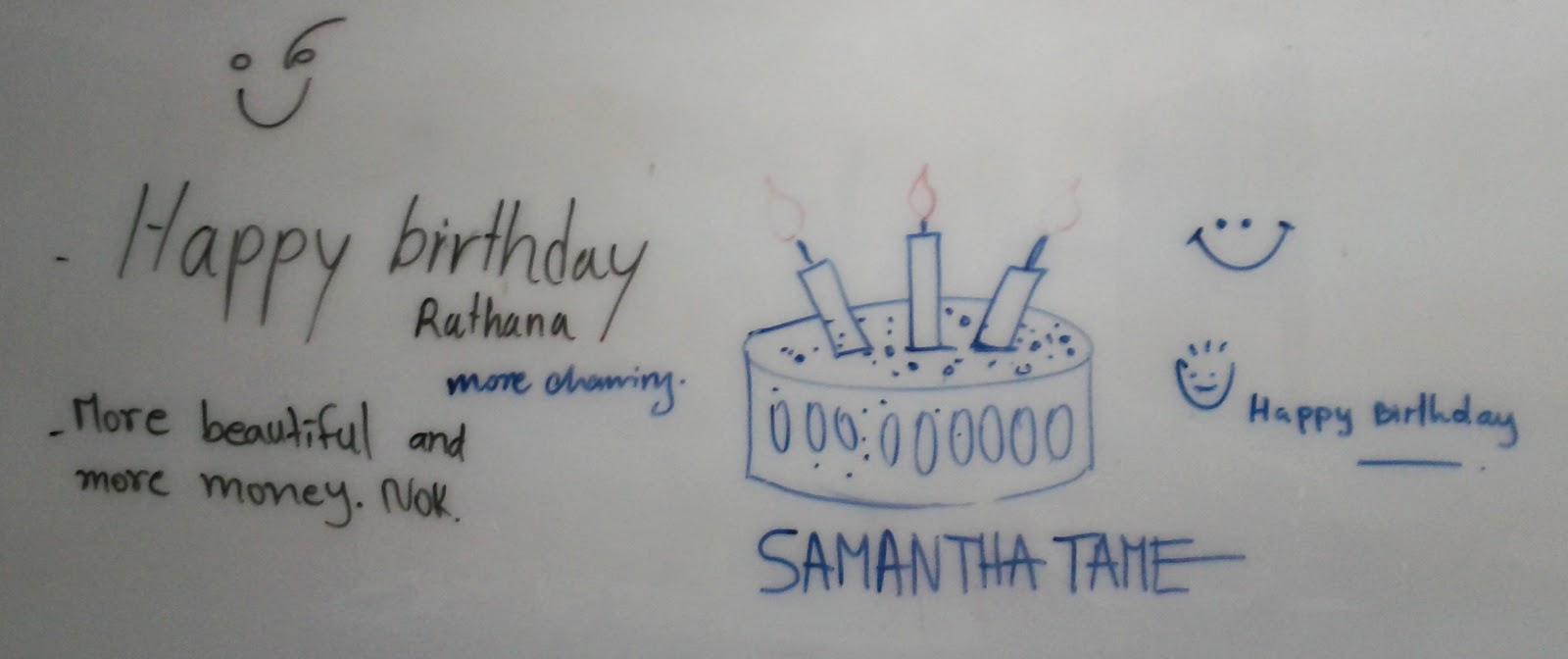
What's good about teaching on your birthday?

This is what's good about teaching on your birthday.


A few of the students were late coming back from the mid-lesson break and I was ready to lecture them on timekeeping. Then they came back with this completely adorable personalised cake.


All is forgiven, late students.

Saturday, 15 February 2014

Passive vs active voice (free printable worksheet)

When I first introduced the passive to my pre-intermediate Cambodian students, their initial reaction was to look at me as if to say, "You're telling me English has another tense? Why, teacher? Why?"

They're definitely warming to it now... I think.

The Oxford textbook that we use tends to jump in at the deep end with grammar points. While the passive may be a breeze for speakers of languages that form it in the same way (eg. French or German), it will understandably take a bit more work for speakers of languages that have no such thing.

To bridge the gap, I made a handout that explains how the passive is formed and what it is used for.

It progresses to some guided practice in the present tense.

Link opens with Google documents, you can then print or download as required